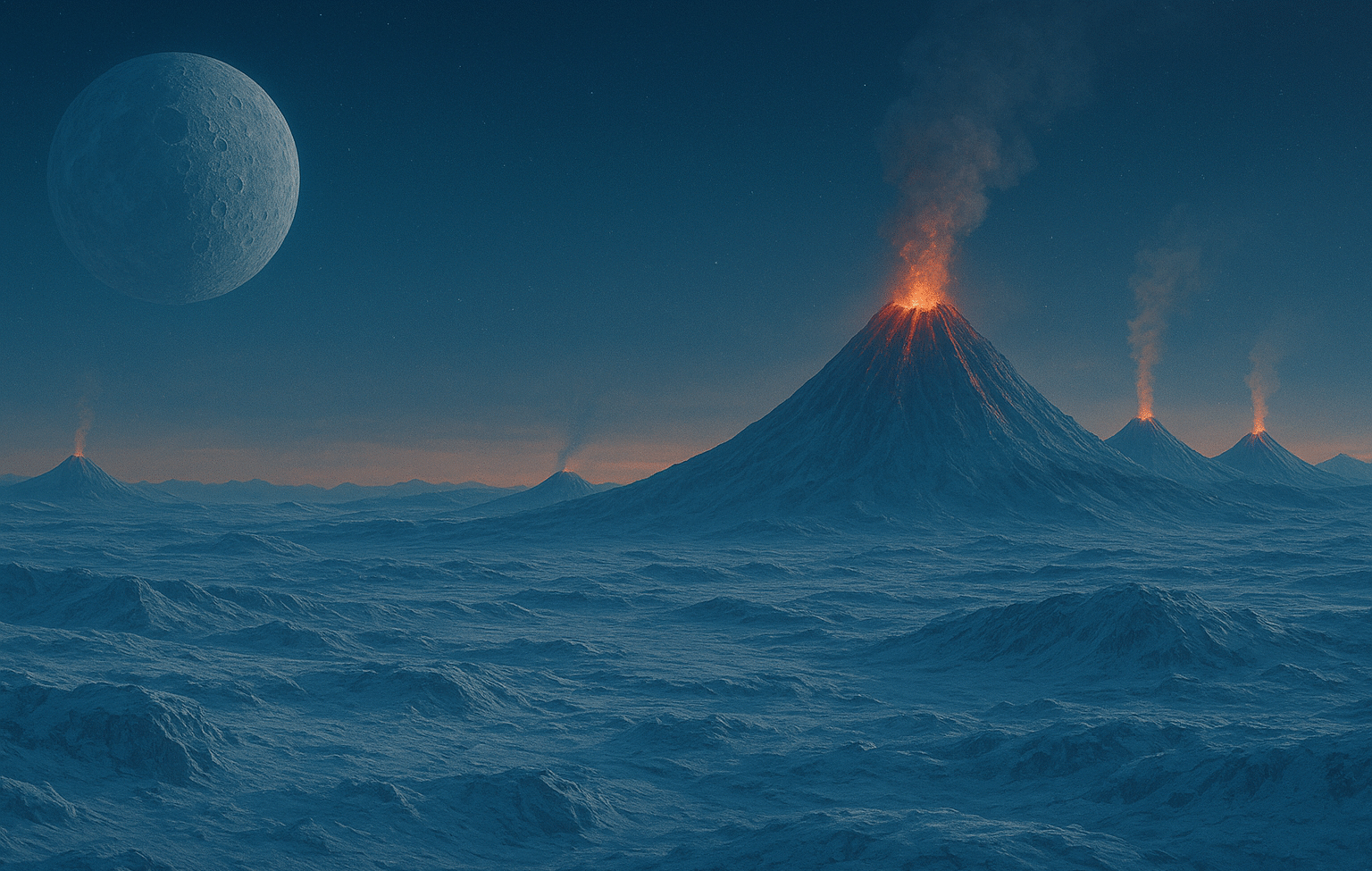
Ice volcanoes detected by 3I/ATLAS

The 3I/ATLAS instrument reveals cryovolcanic activity on distant celestial bodies, challenging paradigms about volcanism and habitability in the cosmos.
The discovery of ice volcanoes redefines the frontier of space geoscience. These are not mere astronomical curiosities: we are talking about dynamic systems capable of sustaining energy and chemical cycles. For astrobiology researchers, this means that the smaller bodies of the solar system, previously considered inert, could become natural laboratories for studying the emergence of life.
Furthermore, the fact that the thermal structures detected by 3I/ATLAS defy the expected patterns of comets suggests that we are dealing with a new type of hybrid interstellar object, with features of both a comet and an active moon.
The discovery made by the 3I/ATLAS instrument marks a turning point in our understanding of volcanic activity beyond Earth. Until recently, volcanism was conceived as a phenomenon exclusively linked to the internal heat of planets and moons with traditional geological activity. However, the thermal images obtained by 3I/ATLAS reveal structures that correspond to ice-water volcanoes, capable of expelling cryogenic materials on celestial bodies previously thought to be inert.
From an astrobiological perspective, ice volcanoes are more than just a geological curiosity: they represent potentially habitable microenvironments. The expulsion of frozen water and volatile compounds could generate niches similar to the geysers of Enceladus or Triton, where chemical and energetic conditions favor the formation of organic molecules. This discovery compels us to rethink space exploration strategies, which should no longer be limited to planets with atmospheres, but should also include moons and comets with cryovolcanic activity.
Furthermore, the hybrid nature of the objects studied by 3I/ATLAS—with features of both comets and active moons—suggests that we are looking at a new category of celestial bodies. This opens up a novel field of research: understanding how these hybrid systems evolve and what role they play in the distribution of water and organic compounds in the universe.
In conclusion, the ice volcanoes detected by 3I/ATLAS not only confirm that the cosmos is more dynamic than we imagined, but also redefine the boundary of extraterrestrial habitability. Life could be hidden beneath layers of ice that are now beginning to reveal their internal energy, becoming natural laboratories for studying the origin and persistence of life under extreme conditions.