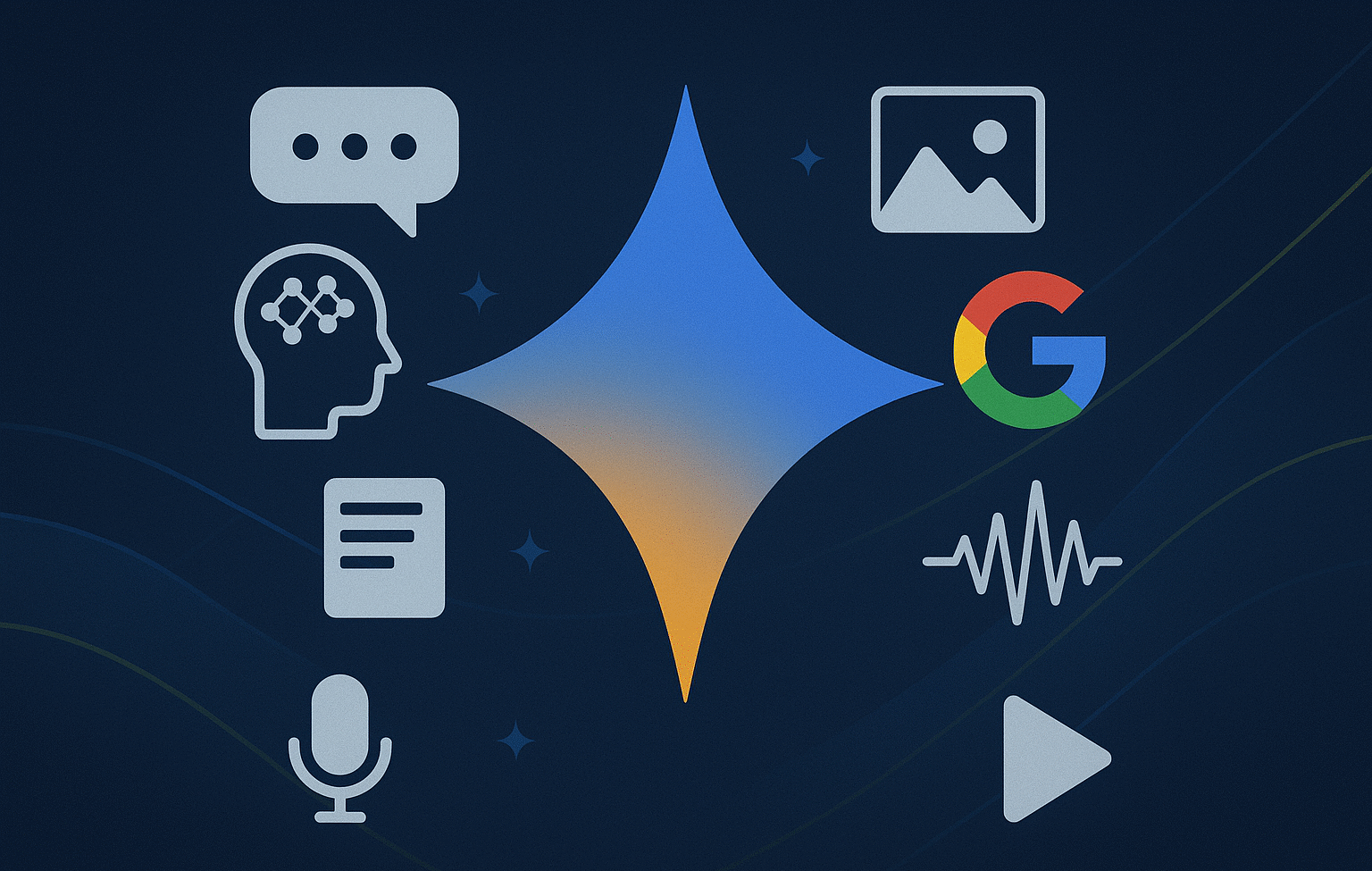
Google launches Gemini 3: Multimodal AI with global leadership ambitions

Google’s new artificial intelligence model redefines digital interaction with advanced multimodal capabilities, challenging OpenAI in the race for cognitive supremacy.
Google has unveiled Gemini 3, its most sophisticated artificial intelligence model to date, with a bold promise: to be the world’s most intelligent and multimodal system. This claim not only aims to position Google against OpenAI and its GPT-4, but also to set a new standard in human-machine interaction.
What does “multimodal” mean? Gemini 3 can simultaneously process text, images, audio, and video. This makes it a digital agent capable of performing complex tasks, from generating audiovisual content to designing on-demand applications. Koray Kavukcuoglu, head of AI at Google DeepMind, describes it as a “universal model” that can adapt to multiple contexts without additional training.
Although multimodality isn’t new (OpenAI is also exploring it), Gemini 3 stands out for integrating these capabilities in real time, which could revolutionize conversational interfaces, virtual assistants, and educational environments. However, independent benchmarks validating its superiority over GPT-4 Turbo or Claude 2.1 have not yet been published. Key point: Google claims that Gemini 3 outperforms all existing models in multimodal understanding. But without open access or comparative testing, this claim remains in the realm of strategic speculation.
• For developers: Gemini 3 promises a more flexible API, capable of generating interfaces, apps, and content without the need for multiple models. This could reduce costs and accelerate product development.
• For businesses: Integration with Google Workspace and Android opens the door to corporate assistants that understand visual, auditory, and textual context.
• For users: The experience becomes more seamless. Imagine asking your assistant to edit a video, write a report, and analyze a medical image, all in a single interaction.
Gemini 3 is more than just a response to OpenAI: it’s Google’s attempt to lead the next generation of intelligent interfaces. If it lives up to its promises, it could be the first step toward truly universal AI. But until independent tests are published, the technical community must maintain a critical and demanding stance.